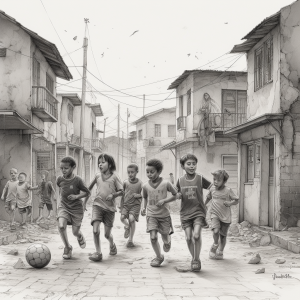
There were two boys.
Same team.
Same age.
Same coach.
Same muddy pitch on the same cold Saturday mornings.
One of them was the kind of player parents pointed at from the sideline.
Quick.
Composed.
The ball seemed to listen to him. By ten he was training with the district squad and the word followed him everywhere he went.
Talented.
The other boy was not pointed at by anyone.
He was, by every measure that seemed to matter back then, “average”. Not the fastest. Not the most skillful. Not the one who made people gasp.
But he showed up.
Every session.
Every drill.
Every cold morning when half the squad found a reason to stay at home.
For years I watched these two boys travel in completely opposite directions.
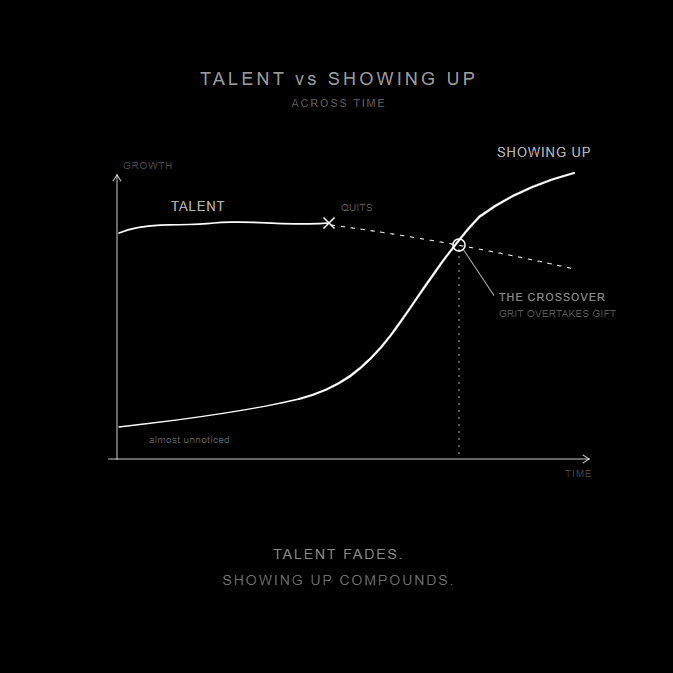
The talented one collected labels. Representative teams. Glowing reports. The quiet certainty of every adult around him that he was going all the way.
The average one just kept training.
And then something happened…
Somewhere around sixteen, the talented boy stopped.
So did most of the others who had worn that label. The ones who had been the best at twelve. The ones whose parents had been so sure.
One by one, they walked away from the game.
And the “average” boy?
He is the only one of them still playing at a semi professional level in this country today.
Guess who that surprises.
Everyone except the people who were really paying attention.
This is about what made the difference. And the difference, it turns out, has a name.
It is soccer motivation, and almost everything most parents believe about it is wrong.
You Cannot Install Motivation
Here is the mistake almost every well meaning parent makes.
They treat soccer motivation like fuel. Something they can pour into their child from the outside.
More pressure.
More structure.
More reminders about how much this costs and how far they could go if they just applied themselves.
Push hard enough, the thinking goes, and the drive will follow.
It never does…
Because motivation does not work that way.
It never has.
Two psychologists spent the better part of their careers proving exactly this. Edward Deci and Richard Ryan, the researchers behind what is known as Self Determination Theory, discovered something that should change the way every parent thinks about their child and the game they love.
Human beings are not motivated from the outside in.
We are motivated from the inside out.
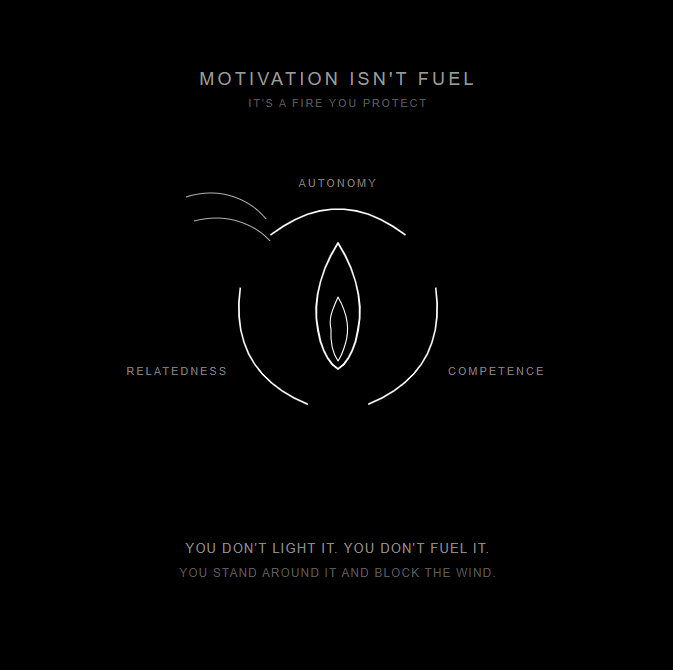
Their decades of research found that lasting motivation, the kind that survives setbacks and boredom and cold Saturday mornings, grows when three basic needs are met. The need to feel in control of our own choices. The need to feel like we are getting better at something. And the need to feel connected to the people around us.
Autonomy. Competence. Relatedness.
Get those three things right and soccer motivation takes care of itself.
Get them wrong, and no amount of pushing from the sideline will save it.
Now hold that “average” boy in your mind for a moment.
Nobody was installing anything in him. Nobody was pouring fuel into the tank. He showed up because he wanted to. He trained hard because getting better felt good to him. He kept coming back because his mates were there and the game was his.
Autonomy. Competence. Relatedness.
He had all three. Quietly. Without anyone planning it.
And the talented boys, the ones who walked away?
Somewhere along the line, usually with the very best of intentions, the adults around them took one or more of those three things away.
That is what the rest of this page is about.
Not how to push your child harder.
How to protect the three things that were always going to keep them playing.
The Over Correction Trap
Let me describe a scene you have almost certainly witnessed.
A child gets the ball. Before they have taken a second touch, a voice arrives.
Pass it. Not there. Turn. Other way. Why did you do that. Look up. Too slow.
The child plays on, and every few seconds another instruction lands. Every decision is met with a correction. Every mistake is named the instant it happens. The voice means well. The voice loves this child more than anything in the world.
The voice genuinely believes it is helping.
It is doing the opposite.
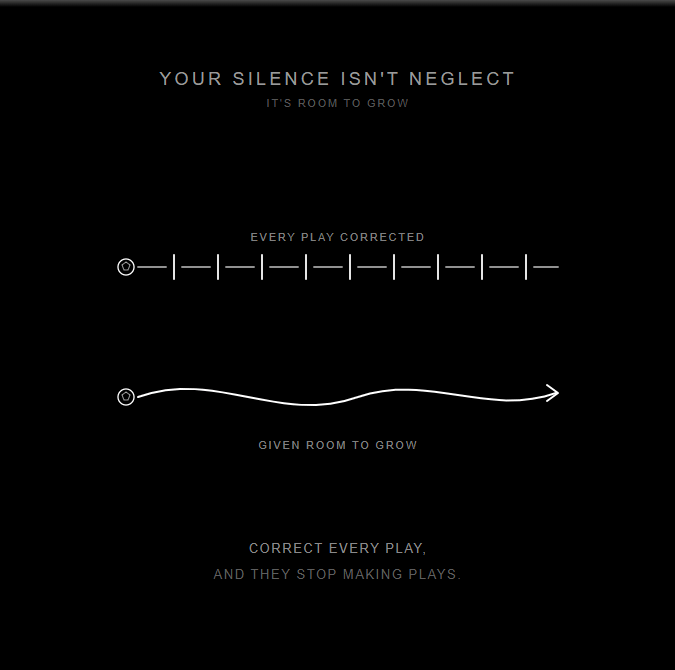
In forty years I have watched no single behaviour drain the soccer motivation out of young players faster than constant correction.
Not pressure to win.
Not early specialisation.
Not even comparison.
Over correction is the quiet killer, because it disguises itself as coaching, and coaching feels like love.
Here is what it actually does.
Remember the three things Deci and Ryan found that motivation depends on. Autonomy. Competence. Relatedness. Over correction attacks all three at once. It is almost surgical in its destruction.
Start with autonomy, the need to feel in control of your own choices.
A child who is corrected on every play stops making choices.
Why would they?
Every decision they make is overridden within seconds. So they stop deciding and start waiting. Waiting for the next instruction. Waiting to be told. The game stops being something they are doing and becomes something being done to them.
You can see it on the pitch if you know what to look for. The child glances to the sideline before they act. Their head comes up not to scan the field but to find the voice. They are no longer playing soccer.
They are taking dictation.
A player who cannot make their own decisions will never fall in love with the game, because the part of the game that is most alive, the deciding, the reading, the trying, has been taken from them.
Now competence, the need to feel like you are getting better.
This is the cruel one. Because the parent correcting every play believes they are building competence. They think they are teaching. But competence is not a feeling that comes from being told what is wrong. It is a feeling that comes from figuring something out and succeeding at it yourself.
When every play is interrupted with a correction, the message a child receives is not you are improving.
The message is you keep getting it wrong.
Relentlessly.
In front of everyone. Dozens of times per game.
No human being feels themselves growing more capable while being told, over and over, that they are failing. They feel the reverse. They feel smaller. Less sure. More hesitant. And a hesitant child plays worse, which draws more correction, which makes them more hesitant still.
That is a spiral.
…and it spins downward.
Then relatedness, the need to feel connected to the people around us.
For most young children, soccer is not really about soccer. It is about their mates. Running around together. Belonging to something. The relatedness need is met simply by being part of the team.
But the over corrected child slowly gets pulled out of that shared experience. While their teammates are lost in the game, laughing, playing, being children, this child is locked in a private feedback loop with a voice on the sideline. They are physically with their friends and emotionally somewhere else entirely.
Managing.
Bracing.
Performing for an audience of one.
The thing that made the game joyful, the togetherness, quietly erodes…
So there it is. One behaviour. All three needs dismantled at once. Autonomy, competence and relatedness, the entire foundation of lasting soccer motivation, taken apart in the space of a single Saturday morning game. Not through cruelty. Through love that did not understand what it was doing.
Now think back to the average boy.
Nobody was standing over him correcting every touch. He was, in the truest sense, left alone to play. To try things. To get them wrong. To work them out. To fail quietly and fix it himself and feel the small private satisfaction of having done so.
He was never the most corrected player on the pitch.
So he was never the most hesitant.
So he kept his autonomy, kept building real competence, kept belonging to the group. The three needs stayed intact.
The engine kept running.
…and the engine is still running today, at a level every one of those corrected, coached, talented boys never reached.
The lesson is hard for a loving parent to hear, because it asks you to do less, and doing less feels like neglect.
It is not neglect.
It is trust.
The single most powerful thing you can do for your child’s soccer motivation on a Saturday morning is to let them play.
Let them decide.
Let them get it wrong.
Let them discover, in their own time and in their own way, the deep and lasting satisfaction of working something out for themselves.
Bite your tongue.
It might be the hardest thing you do all weekend.
It might also be the most important.
The Trophy Problem
We need to talk about rewards.
Because most parents, trying to motivate their child, reach instinctively for the same tool.
The reward.
Score a goal and we will get ice cream.
Win the game and there is a treat in it.
Play well this season and we will talk about those new boots.
It seems harmless.
It seems generous.
It seems, on the surface, like exactly the kind of encouragement a loving parent should offer.
And it slowly poisons the thing it is trying to grow.
Daniel Pink, who spent years studying what actually drives human behaviour and laid it out in his book Drive, describes two fundamentally different kinds of motivation. There is intrinsic motivation, which comes from inside. You do something because the doing itself is rewarding. And there is extrinsic motivation, which comes from outside. You do something to earn a reward or avoid a punishment.
Here is the part that should stop every soccer parent cold.
When you take an activity that a child already loves, an activity they are intrinsically motivated to do, and you attach an external reward to it, you do not add motivation.
You replace it.
The research on this is decades deep and remarkably consistent. Reward a child for something they already enjoy, and their enjoyment of the thing itself begins to fade. The reward quietly becomes the reason. And the moment the reward stops, or stops being big enough, so does the desire.
A child who plays for ice cream will only play as long as there is ice cream.
A child who plays for the love of playing will play forever.
You can see how this connects to everything we have talked about. The goal was never to get your child playing for a season. It was to protect a love that lasts a lifetime. And every external reward you attach to the game, however well meant, trades a little bit of that lasting love for a short term burst of effort.
It is a bad trade. And you make it without ever realising.
Now here is where it gets uncomfortable.
Because the most powerful reward in youth soccer is not ice cream, or money for goals, or new boots.
It is a word.
Talented.
Think back to those two boys. One of them was handed that word early and often. By coaches. By parents. By every adult who watched him play. And what nobody understood at the time was that the word itself was a reward. An external label that the boy began, without anyone noticing, to play for.
Carol Dweck, the Stanford psychologist whose research on mindset has reshaped how the world thinks about achievement, found something extraordinary about praising children for talent.
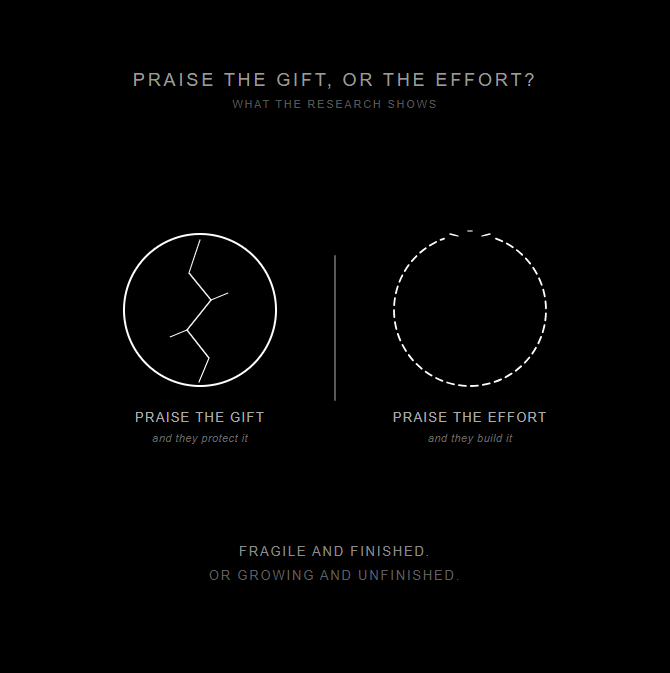
When you praise a child for being talented, for being a natural, for being gifted, you do not build their confidence.
You make them fragile.
Because a child praised for talent comes to believe that talent is who they are. And the moment the game gets hard, the moment they face an opponent who is better, the moment they have to struggle, that struggle does not feel like growth.
It feels like a threat.
If I am talented, and this is hard, what does that say about me?
So the talented child learns, quietly, to avoid the very thing that would make them better. They stop taking risks that might expose a limit. They retreat from challenges that might crack the label. They protect the identity instead of developing the player.
And eventually, when the gap closes, when the kids who were never called talented catch up and overtake them through sheer accumulated effort, the talented child has no answer. Their whole identity was built on being naturally better. Once that is gone, there is nothing underneath to fall back on.
So they walk away.
Not because they lost their ability.
Because they lost the story they had been told about themselves.
The average boy was never given that story.
Nobody called him a natural, because he wasn’t one. Nobody told him he was gifted, because by the visible measures of the time, he wasn’t.
So he was free.
Free to struggle without it meaning anything about his worth. Free to be worse than someone else and simply work to close the gap. Free to fail on a Tuesday night in training and come back Wednesday without an identity to defend.
What looked like a disadvantage, not being labelled talented, turned out to be the greatest gift he was ever given.
He got to fall in love with getting better.
And getting better, it turns out, is a love that never runs out.
So the question for you as a parent is not how do I make my child feel talented.
It is the opposite.
How do I praise my child in a way that builds something that lasts?
The answer, from Dweck’s research and from forty years of watching it play out on real pitches, is simple to say and hard to do.
Praise the effort, not the gift.
Praise the training they showed up to, not the goal they scored. Praise the difficult thing they attempted, not the easy thing they pulled off. Praise the getting back up, not the not falling down.
Because effort is something a child can always repeat.
Talent is something they are terrified to lose.
Give your child the one you can build on.
Fun Is Not the Opposite of Serious
Somewhere along the way, youth soccer absorbed a damaging idea.
That fun and development are opposites.
That there comes a point, usually earlier than it should, when the fun has to be set aside so the real work can begin. When training stops being play and starts being serious. When laughter on the pitch becomes a sign that the kids are not focused enough, not working hard enough, not taking it seriously enough.
It is one of the most expensive misunderstandings in the entire game.
Because fun is not the thing that gets in the way of development.
Fun is how development happens.
Think about what is actually occurring when a child is having fun on a soccer pitch. They are relaxed, which means their body moves freely and learns faster. They are engaged, which means they are fully present and absorbing everything. They are willing to try things, which means they are taking the risks that growth requires. And they want to come back tomorrow, which means the single most important factor in long term development, time on the ball over years, is protected.
A child having fun is a child learning at full capacity.
A child who has stopped having fun is a child whose development has quietly stalled, no matter how serious the training has become.
We met this idea in passing once before, in the research of Amanda Visek, whose study mapping the things that make sport fun for young athletes found that winning ranked forty eighth out of eighty one. Down at number forty eight, well below trying your best, below playing well together, below the simple joy of moving and being with friends.
Children are telling us, clearly and consistently, what keeps them in the game.
And it is almost never the thing the adults are focused on.
Here is where I want to bring back the average boy one more time, because his story holds a detail that is easy to miss.
He trained hard. Relentlessly, in fact. By any measure he was one of the most dedicated players I ever coached.
But here is the thing people always assume and always get wrong.
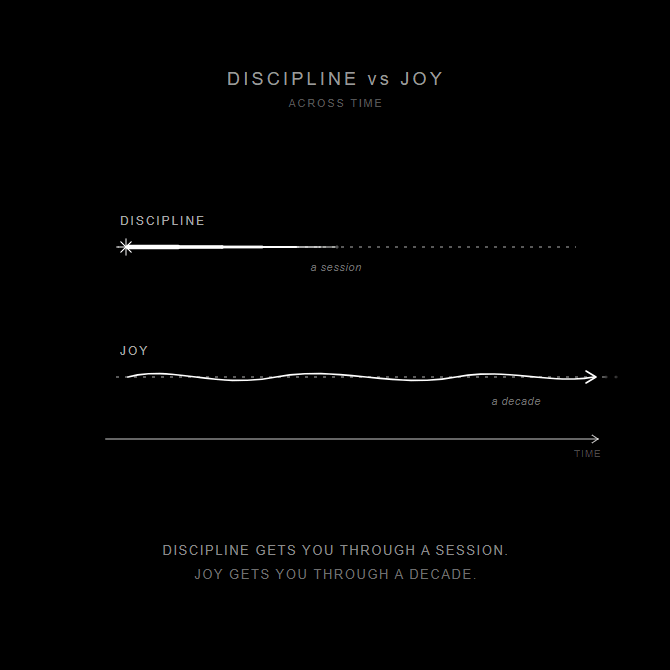
His dedication did not come from discipline.
It came from joy.
He was not grinding through training with gritted teeth because some adult had convinced him it was the price of success. He was there because he loved it. The hard work was not the opposite of fun for him. The hard work was the fun. The repetition, the trying, the slow accumulation of small improvements, all of it was deeply, quietly enjoyable to him.
That is the secret that the serious soccer culture never understands.
The hardest working players are almost never the ones being pushed the hardest.
They are the ones having the most fun.
Because fun is what makes effort sustainable. Discipline gets you through a session. Joy gets you through a decade. And it is the decade, not the session, that produces a player still standing at the end.
So when you watch your child mucking about at training, laughing with their teammates, trying an outrageous trick that has almost no chance of working, resist the urge to call them back to seriousness.
That is not a distraction from their development.
That is their development, happening exactly as it should.
The laughter is not noise getting in the way of the learning.
The laughter is the sound of a child who will still be playing long after the serious ones have gone home for good.
Protect it like the precious thing it is.
Because it is the precious thing. It always was.
Falling in Love With Getting Better
There is a particular kind of player who never burns out.
You can spot them if you know what to look for. They are not always the most gifted. They are rarely the loudest. But there is something in the way they train, a quiet absorption, a hunger that has nothing to do with the scoreboard.
They have fallen in love with getting better.
Not with winning. Not with being the best. Not with the praise or the trophies or the label.
With the process itself. The slow, patient, deeply satisfying act of being a little better today than they were yesterday.
This is the mastery mindset, and it is the closest thing to a guarantee of lasting soccer motivation that I have ever witnessed.
Carol Dweck’s research, which we met earlier, gives us the language for it. A child with a growth mindset believes their ability is not fixed but can be developed through effort. And that single belief changes everything about how they experience the game.
A mistake is no longer a verdict. It is information.
A defeat is no longer a humiliation. It is a lesson.
A more skillful opponent is no longer a threat. They are a glimpse of what is possible.
The child who has fallen in love with getting better is, in a very real sense, unbreakable. Because the things that destroy other players, the setbacks, the plateaus, the bad games, are the very things that feed them. They have built their motivation on the one foundation that adversity cannot erode.
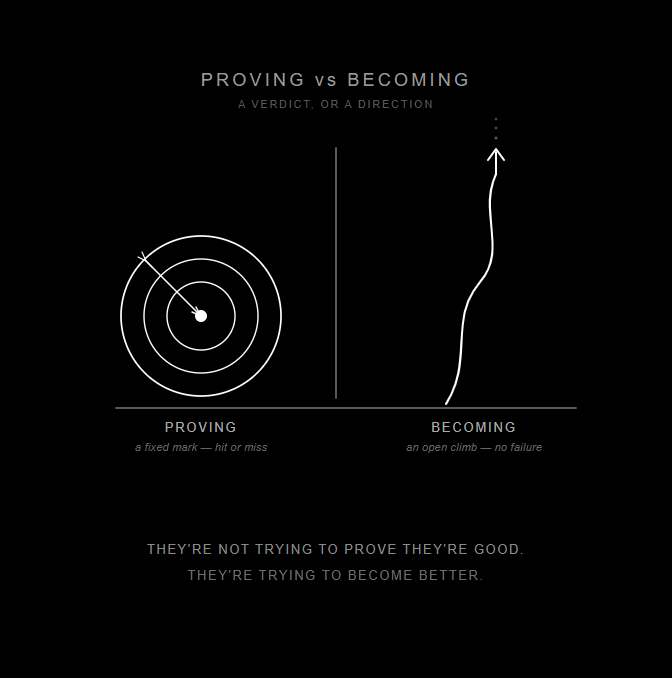
They are not trying to prove they are good.
They are trying to become better.
And those are completely different games, played by completely different children, with completely different endings.
Angela Duckworth, a psychologist at the University of Pennsylvania, spent years trying to understand why some people sustain effort over the long term while others fall away. She studied cadets at military academies, students, athletes, professionals. And she found that the quality that predicted who would last was not talent, not intelligence, not natural advantage.
It was grit. The combination of passion and perseverance, sustained over years, in pursuit of something that genuinely matters to the person.
Read that again with the average boy in mind.
Passion and perseverance, sustained over years.
That is his entire story in five words. He was not the most talented. He was the most persistent, and his persistence was fuelled by a passion nobody installed and nobody could take away. He had grit before anyone gave it a name, and grit, it turns out, is what was still standing when the talent had long since walked off the pitch.
But here is the part of Duckworth’s work that matters most for you as a parent.
Grit is not something you are born with.
It grows. In the right conditions. And it withers in the wrong ones.
It grows in a child who is allowed to struggle and discover they can survive it. It grows in a child who is praised for effort rather than gift. It grows in a child who is given the autonomy to own their own development. It grows, in other words, in exactly the conditions this entire page has been describing.
And it withers under pressure, over correction, conditional love, and the relentless message that only winning counts.
You do not give your child grit.
You create the conditions in which it can grow.
And then, hardest of all, you step back and let it.
Here is what falling in love with getting better actually looks like on a Saturday morning. It does not look like fist pumps and trophies. It looks quieter than that.
It looks like a child who tries the difficult skill in a real game, fails, and tries it again the very next chance they get. It looks like a child who is more interested in the thing they could not do than the things they could. It looks like a child who comes off the pitch after a loss already talking about what they want to work on.
If you see that in your child, protect it with everything you have.
Because that child has found the one thing that lasts. Not talent, which fades. Not victory, which is temporary. Not praise, which runs out.
The love of becoming.
It is the engine that runs for a lifetime. It was running in the average boy when he was eight, and it is still running in him now, on a semi professional pitch, decades after every talented boy he started with stopped.
That engine was always available to every one of those boys.
Only one of them was allowed to keep it.
How Soccer Motivation Actually Grows
We have spent this whole page circling three words. It is time to put them to work.
Autonomy.
Competence.
Relatedness.
Deci and Ryan gave us these as the three needs that lasting soccer motivation depends on. We have seen how over correction destroys all three at once. Now let us turn it around completely and look at how a parent protects and feeds each one.
Not in theory.
In the car, on the sideline, at the dinner table, on match day.
Because this is the part that matters. Understanding the science is interesting. Living it is what changes your child’s life in the game.
Autonomy: Let It Be Theirs
Autonomy is the need to feel in control of your own choices. And it is the one parents accidentally strip away most often, because handing control to a child feels, to a loving parent, like handing them a risk.
But a child who does not own their soccer will never love their soccer.
So let it be theirs. Genuinely theirs.
Let them choose whether to do the extra practice in the backyard, rather than marching them out to it. Let them make their own decisions on the pitch and live with the consequences, rather than deciding for them from the fence. Let them have a real say in how much they play, what position they want to try, whether they want to go to the optional session.
When a child feels that soccer is something they are choosing rather than something being imposed on them, the entire relationship changes. Effort that is forced is fragile. Effort that is chosen is durable. The same training session that drains a child when it is demanded of them energises that child when it is their own decision.
The hardest version of this is the backyard. So many parents push their child to practice more and cannot understand why the child resists. The answer is almost always autonomy. The moment practice becomes the parent’s idea, it stops being the child’s joy. Step back. Leave a ball by the door. And watch what happens when the choice becomes theirs again.
Competence: Let Them Feel the Climb
Competence is the need to feel yourself getting better. Not to be the best. To be improving. And the distinction is everything.
A child does not need to be winning to feel competent. They need to feel progress. The small, specific, unmistakable sense that the thing that was hard last month is a little easier now.
Your job is to help them see that climb, because children often cannot see it in themselves.
This is where the language you choose does its quiet work. When you notice and name a specific improvement, you are not just praising. You are holding up a mirror that shows your child their own growth. You did not used to be able to do that. Last season you would not have won that ball. Your weaker foot is getting stronger, I can see it.
Notice these are not comparisons to other children. They are comparisons to your child’s own past self. That is the only comparison that builds competence. Measured against a teammate, a child feels behind. Measured against who they were, a child feels themselves climbing.
And resist the urge to smooth the path. Competence cannot grow without challenge, because a feeling of mastery that was never tested is hollow and the child knows it. The satisfaction your child is built to crave is the satisfaction of having struggled with something and overcome it. Take away the struggle and you take away the prize.
Let it be hard. Then help them see how far they have climbed.
Relatedness: Let Them Belong
Relatedness is the need to feel connected to the people around us. For most children, it is the deepest reason they play, even though it is the one adults take least seriously.
They are not there for the tactics. They are there for their mates.
So protect that above almost everything. The friendships, the belonging, the feeling of being part of something with other children. When parents move a child from team to team chasing a better level, or a stronger coach, or more game time, they often win the thing they were chasing and lose the thing that was actually keeping their child in the game. The belonging.
Relatedness is also about you. A child needs to feel connected to their parent through the game, not evaluated by them through it. This is the whole argument of our companion page on the sideline parent, and it lives here too. When your child associates soccer with warmth, connection and time with you, the game becomes doubly precious to them. When they associate it with judgement and tension, the relatedness need goes unmet, and a powerful source of soccer motivation quietly drains away.
Be the reason the game feels like belonging. Never the reason it feels like pressure.
Three needs. Autonomy, competence, relatedness.
Protect all three and you will almost never have to motivate your child at all. The motivation will already be there, growing on its own, exactly as it was designed to.
That is the great secret hidden inside all this research.
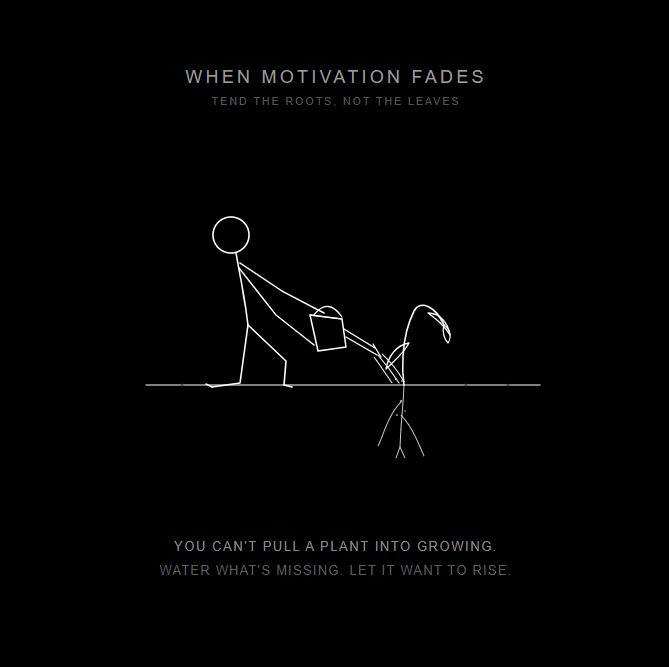
You were never meant to be the source of your child’s motivation.
You were meant to be the gardener who protects the conditions in which it grows itself.
When the Spark Has Already Dimmed
Maybe you are reading this too late.
Maybe the child you are picturing is not bounding out of the car on a Saturday morning. Maybe they are quiet now. Flat. Going through the motions. The shrug when you ask how training was. The fine that means nothing. The boots that get pulled on slowly, without the old urgency.
You can feel it. Something that used to be there has dimmed.
And every instinct in you is screaming to do something about it. To push. To motivate. To inject some urgency before it slips away completely.
Put that instinct down. Gently. It is the most dangerous one you have right now.
Because a dimming spark is not put out by too little pressure. It is put out by too much. And the parent who responds to a flat child by pushing harder is pouring water on the last warm ember, certain they are fanning a flame.
The spark can come back. I have watched it return in children everyone had written off, including, sometimes, themselves. But it does not come back on command, and it does not come back through force. It comes back the same way it grew in the first place. Through the three needs, quietly restored.
Start by asking what was taken.
A child does not usually go flat for no reason. Somewhere, one of the three needs stopped being met, and the spark dimmed in response. Your job is not to push the child. It is to find what went missing and give it back.
Has their autonomy gone? Has the game slowly become something done to them rather than chosen by them? Too many sessions they did not ask for, too many instructions, too much of the experience controlled by adults? Then the way back is to hand the choices back. Let them have a real say. Let them decide whether to go to the optional training. Let them even consider stopping, properly and without punishment, because a child who is allowed to leave is a child who gets to choose to stay. Nothing reignites ownership like genuinely being given it.
Has their sense of competence gone? Have they hit a wall, stopped feeling themselves improve, started to suspect they are simply not good enough? Then the way back is to help them feel the climb again, somewhere small and safe. Not a comparison to the better player. A return to their own progress. A focus on one specific thing they can get visibly better at, away from the pressure of the game, where the satisfaction of mastery can be felt again, quietly, for its own sake.
Has their relatedness gone? Have they lost a friend from the team, fallen out with a coach, stopped feeling like they belong? This one is often invisible to parents because it has nothing to do with the soccer itself, but it ends more young careers than any loss of skill. A child will walk away from a game they love to escape a place they no longer feel they belong. If this is what went missing, no amount of technical encouragement will touch it. The belonging has to be repaired first.
Notice what none of this is.
None of it is a motivational talk. None of it is reminding them how much it costs, or how good they could be, or how much they will regret quitting. None of it is pressure dressed up as encouragement.
It is the patient, unglamorous work of finding the need that went unmet and meeting it. And then waiting. Without an agenda. Without a deadline. Without making your child feel that your mood now depends on their spark returning, which only adds the very pressure that put it out.
Sometimes, in that space, the spark catches again on its own.
And sometimes it does not, and your child moves on from soccer to something else, and that has to be allowed to be okay. Because the goal was never to keep them playing at all costs. The goal was to make sure that if they stayed, they stayed for love, and if they left, they left whole, with the door open and the good memories intact.
But far more often than you would believe, a child whose needs are quietly restored finds their own way back to the game.
Not because they were pushed.
Because they were finally, after all of it, just allowed to want it again.
What to Do This Saturday
Everything on this page comes down to a handful of things you can start this weekend.
No theory here. Just the doing.
Let them decide. On the pitch, in the backyard, about the optional session. Hand your child the choices that are rightfully theirs and resist taking them back. Ownership is where the love lives.
Praise the effort, never the gift. Not the goal, the run that made it. Not the win, the not giving up. Praise what they can repeat, never what they are afraid to lose.
Bite your tongue. For one whole game, correct nothing. Let them try, fail, and work it out themselves. Your silence is not neglect. It is room to grow.
Measure them against themselves. Never against the better kid, the sibling, or who you were at their age. Only against who they were last season. That is the only comparison that builds a player.
Protect the fun. When they are mucking about, laughing, trying the outrageous trick, leave them be. That is not a distraction from their development. That is their development.
Guard the belonging. The friendships and the feeling of being part of something matter more than the level, the coach, or the game time. Lose the belonging and you lose the player.
And if the spark has dimmed, do not push. Find what went missing, give it back, and wait without an agenda.
That is the whole job.
Not to light the fire. Not to fuel it.
To stand around it, block the wind, and let it burn.
Frequently Asked Questions
How do I motivate my child to play soccer?
You cannot install soccer motivation from the outside. Lasting drive grows when three needs are met: autonomy, the freedom to make their own choices; competence, the feeling of getting better; and relatedness, a sense of belonging. Protect those three and motivation looks after itself. Push from the outside and it fades.
Why has my child lost interest in soccer?
A child usually goes flat because one of their core needs stopped being met. They may have lost ownership of the game, stopped feeling themselves improve, or lost a sense of belonging on the team. Find what went missing and restore it. Pushing harder almost always makes it worse.
Should I reward my child for scoring goals or winning?
Be cautious. Research shows that attaching external rewards to an activity a child already enjoys can replace their natural love of it. A child who plays for ice cream plays only while there is ice cream. Reward the effort and enjoyment instead, and protect the love that lasts a lifetime.
Is it bad to call my child talented?
Praising talent can quietly backfire. Children praised for being gifted come to fear losing that label, so they avoid challenges that might expose a limit. Children praised for effort embrace challenge, because effort is something they can always repeat. Praise the work, not the gift.
Does my child need to specialise early to succeed in soccer?
No. Early specialisation increases the risk of burnout and injury, and rarely produces the long term players parents hope for. Children develop best with variety, rest and freedom to enjoy the game. The players still standing years later are usually the ones who were allowed to simply love it.
How important is fun in youth soccer?
Fun is not the opposite of development. It is how development happens. A child having fun is relaxed, engaged, willing to take risks, and wants to come back tomorrow. Enjoyment is the single biggest predictor of whether a child keeps playing, which makes it the foundation of long term soccer motivation.
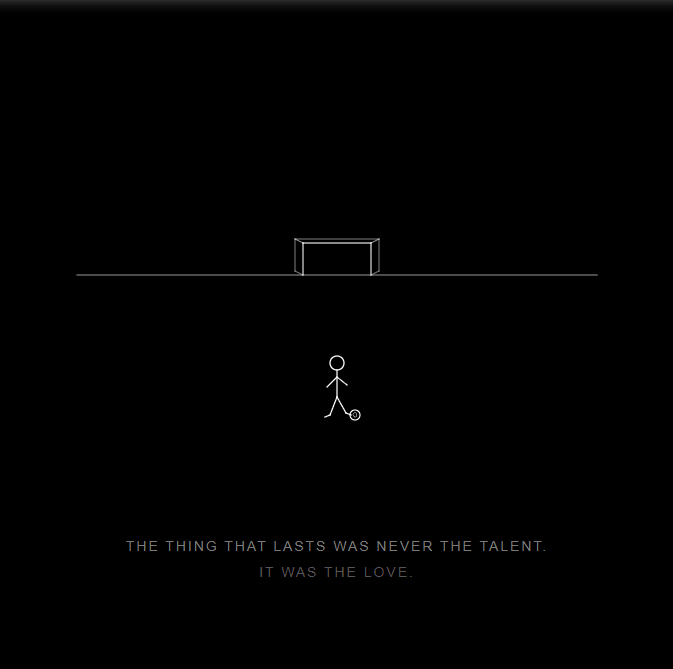
The Last One Standing
I want to leave you with the two boys.
Because their story is not really about soccer. It is about what happens to any child when we mistake the things that glitter for the things that last.
One boy was given every advantage the game can offer a child. The talent, the praise, the labels, the certainty of every adult who watched him that he was going all the way. And one by one, those very advantages became the weight that pulled him under. The label he had to protect. The praise he had to keep earning. The identity that shattered the moment the game got hard.
The other boy was given almost none of it. Just a ball, a team, and the freedom to fall in love with getting better on his own terms.
Guess which one is still playing.
You already know. You have known since the first paragraph. Because somewhere inside, every parent knows that the thing that lasts was never the talent.
It was the love.
And here is what that means for you, on an ordinary weekend, with your own child pulling on their boots by the door.
You do not have to manufacture their soccer motivation. You were never able to anyway. The drive your child needs is already in them, the same way it was already in that average boy, waiting only for the conditions that let it grow.
Your job is smaller than you feared and more important than you knew.
Give them the freedom to make it theirs. Help them feel themselves getting better. Protect the friendships and the fun and the belonging. Praise the effort, never the gift. And when every instinct tells you to push, to correct, to fix, to fan the flame harder, do the bravest thing a soccer parent can do.
Step back.
And let it burn on its own.
The talented boys went home a long time ago.
The one who simply loved it is still out there.
Make sure your child gets to be the one still standing.
Soccer Mastermind exists for one reason. To keep kids in love with the game. Not through better tactics or fancier training drills. But by helping the most important people in a young player’s life.
You, the parent.