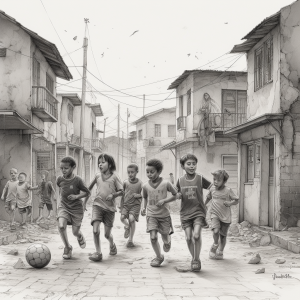
Do you remember the first time your child kicked a ball?
Not the first training session.
Not the first game.
The very first time in the backyard, or the park, or the hallway where they knocked something over and you didn’t even care because the look on their face was everything.
That look.
That pure, uncomplicated joy.
It’s still in there.
I promise you it is.
But something is threatening it.
And if we’re honest really honest.
That something is often us.
The Crisis Nobody Wants to Talk About
Here’s a number that should stop every soccer parent cold.
Seventy percent.
That’s the percentage of children who quit organised sport before the age of thirteen.
Not some kids.
Not troubled kids.
Most kids.
Seventy out of every hundred children who lace up their boots, make friends, learn to pass and tackle and fall and get back up.
Gone.
By thirteen.
The Aspen Institute’s State of Play report has been telling us this for years. Research from the Sports & Fitness Industry Association confirms it. Youth soccer participation peaks around age eight and falls steadily from there.
We are losing them.
And the hardest truth I’ve learned in forty years of playing and coaching.
From the NSL to muddy Saturday mornings with U8s here in Melbourne is that we are usually the reason why.
Not the kids.
Us.
Why do Kids Quit Soccer?
Most children don’t quit soccer because they stop loving the game.
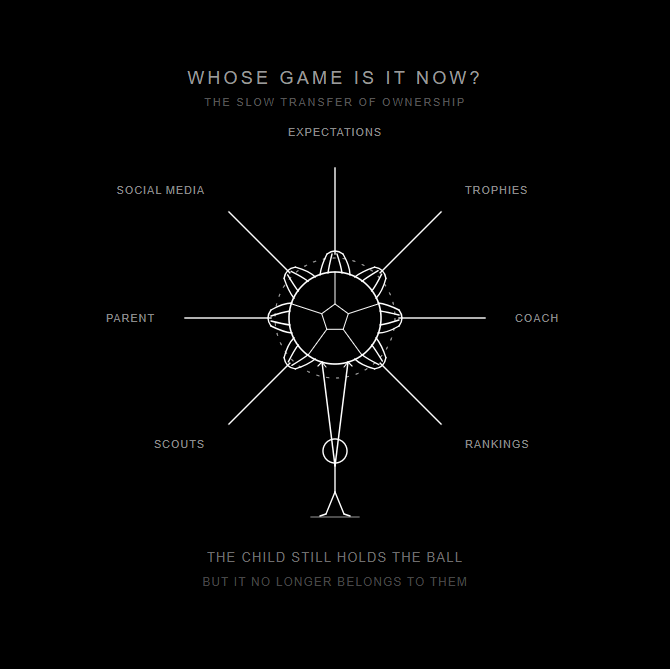
They quit because something — or someone — made it stop feeling like theirs.
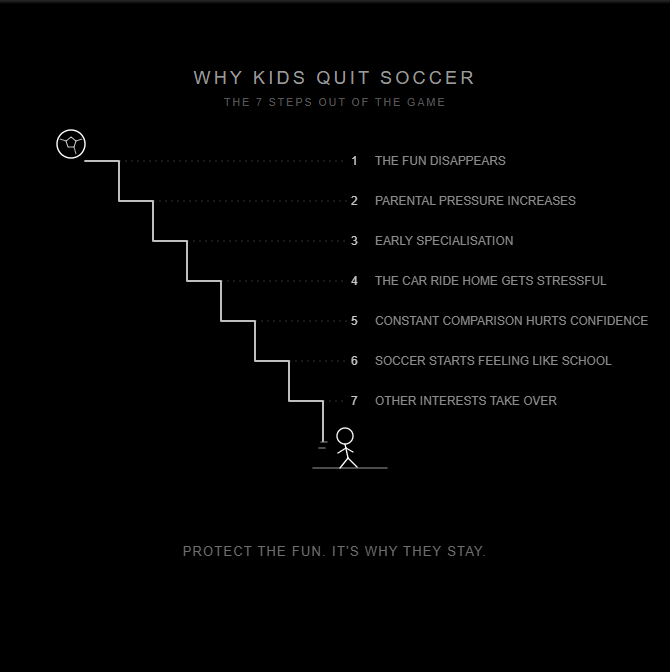
After forty years playing and coaching, the reasons I see over and over again come down to these seven things.
Top 7 Reasons Kids Quit Soccer
- The Fun Disappears
- Parental Pressure Increases
- Early Specialisation
- The Car ride home becomes stressful
- Constant Comparison damages Confidence
- Soccer starts feeling like school
- Other interests become more important
And at the heart of almost every one of these reasons sits the same enemy.
Not competition.
Not screen time.
Not kids being lazy or soft or distracted.
The enemy is pressure without joy. Expectation without empathy. Love that accidentally looks like criticism.
We don’t mean to do it. Every parent I’ve ever met has meant well. Every single one.
But meaning well and doing well are not always the same thing.
Reason 1: The Fun Disappeared Before the Love Could Take Root
Picture this.
Saturday morning.
Crisp air.
The smell of cut grass. Your child sprints onto the pitch with their socks pulled up and their eyes wide and nothing in the world matters except that ball.
That moment is not decoration. That moment is the whole point.
Dr. Amanda Visek from George Washington University spent years researching what actually makes sport fun for young athletes. She identified eighty-one separate fun factors.
Winning was number forty-eight.
Forty-eight.
Read that again.
Yet walk along any youth soccer sideline on a Saturday morning in Australia and you’d think winning was number one. You’d hear it in the instructions being shouted. You’d feel it in the tension when the scoreline shifts. You’d see it in the faces of parents who drove forty minutes to watch their seven-year-old play and cannot, for the life of them, just let it be fun.
When the pressure to perform overtakes the joy of playing, something quietly breaks inside a young footballer. The game stops being theirs. It becomes ours to analyse.
Ours to critique.
Ours to fix.
And the moment a child stops feeling ownership of their own experience on that pitch?
They start looking for the exit.
So try this…
This weekend, ban the word “should” from your vocabulary entirely.
No “you should have passed.”
No “you should have tracked back.”
Just watch.
Just cheer.
Be present without an agenda.
See what happens to your child’s body language when the weight of your expectations lifts even a little.
You might surprise yourself with what you notice.
Reason 2: Parental Over-Coaching the Silent Joy Thief
This is the uncomfortable one. The one that makes parents shift in their seats.
But I’m not here to make you comfortable. I’m here to help you keep your child in the game.
A 2019 study published in the Journal of Sports Sciences found that parental pressure is one of the strongest predictors of dropout in youth sport.
Not coaching quality.
Not facilities.
Not competition level.
Parental pressure.
I’ve watched it happen hundreds of times. A parent who loves their child so fiercely it aches who wants nothing more than to see them succeed standing at the fence, arms crossed, calling out instructions that their child can hear from twenty metres away.
The parent thinks they’re helping. The child hears something else entirely.
They hear: You’re not doing it right.
They hear: I’m watching. Don’t disappoint me.
They hear: My mood depends on your performance.
None of those messages were sent. Every single one was received.
Here’s what the research tells us. Children develop their sense of self largely through the feedback of the adults who matter most to them. Who they are. What they’re capable of. Whether they are enough.
All of it shaped, day by day, by the words and reactions of the people they love most.
When a parent’s approval feels tied to performance, the child doesn’t just feel pressure about soccer. They begin building a story about themselves. A quiet, powerful story that says: I am only good enough when I get it right.
That story doesn’t stay on the pitch. It follows them into the classroom.
Into friendships.
Into every challenge they face for the rest of their life.
That story follows them off the pitch.
Into the classroom.
Into relationships.
Into life.
Your sideline behaviour isn’t just about soccer.
It’s about the person your child is becoming.
So give yourself one job this weekend.
Just one.
Be a fan.
Not a coach.
Not an analyst…
A fan.
Cheer the effort.
Cheer the hustle.
Cheer the kid who gets up after being knocked into the advertising board and keeps running.
That’s it.
That’s the whole brief.
You might find it’s harder than it sounds.
And that difficulty is worth paying attention to.

Reason 3: Early Specialisation and the Burnout Trap
I had a parent come to me last season. Lovely family. Dedicated. Their eight-year-old was training five days a week, playing in two competitions, and doing private coaching on weekends.
They asked me if it was enough.
I asked one question: Does your child still smile when they talk about soccer?
The silence told me everything.
The American Academy of Pediatrics is unambiguous on this. Early specialisation in a single sport before the age of twelve significantly increases the risk of physical injury and psychological burnout.
Children need variety.
They need rest.
They need to kick a ball in the backyard for no reason at all sometimes.
The fear that drives early specialisation is understandable. We worry our child will fall behind. That the other kids are getting ahead. That talent waits for no one.
The pressure to specialise early is one of the fastest routes to a child who resents the very sport you’re trying to give them.
So ask your child this week what other sports or activities they’d love to try.
No agenda.
No quietly steering them back to soccer.
Just listen. Really listen.
You might be surprised by what you hear.
And here’s the thing, whatever it is, it will probably make them a better soccer player.
Movement…
Confidence…
Coordination…
Joy…
It all transfers.
Reason 4: The Car Ride Home
Ten minutes.
That’s all it takes to either strengthen or fracture your child’s relationship with soccer.
Research consistently shows that the period immediately after a game is when children are most emotionally raw and least receptive to feedback. Their nervous system is still processing the experience. Their self-esteem is tender. They are not ready for a debrief.
Yet it’s precisely the moment most parents choose to coach.
“Why didn’t you track back in the second half?”
“You had so many chances you really should have scored.”
“I don’t think you were trying hard enough out there.”
I’ve spoken to former youth players. Adults now, with kids of their own. And here’s what stays with me about those conversations. They remember almost nothing about the actual soccer. Not the goals they scored. Not the games they won. Not the skills they spent years developing.
But they remember the car ride home.
Word. For. Word.
Those conversations didn’t just sting in the moment. They rewired the relationship between that child and the game. Between that child and their parent. Between that child and their own belief in themselves.
Dr. Amanda Visek’s research identified the single most powerful thing a parent can say after any game.
“I love watching you play.”
That’s it. Nothing else required. No analysis. No coaching. No suggestions for improvement.
Just that.
Try it this weekend. It will feel incomplete. Like you haven’t done your job. That discomfort is important, it’s telling you something about the role you’ve been playing.
So try the 24-hour rule.
Zero performance feedback for twenty-four hours after the final whistle.
If your child wants to talk about the game, let them lead.
Ask what they enjoyed.
Ask what made them laugh.
Let them own the story.
You’ll be amazed how much more they open up when they know the conversation belongs to them.
Reason 5: Comparison the Quickest Way to Extinguish a Flame
Every team has that kid.
You know the one. Head and shoulders above the rest. First to the ball. Last to make a mistake. The kid who makes it look effortless at an age when most children are still working out which foot is their left.
And every team has a parent who can’t stop referencing that kid.
When a child is constantly compared to teammates, to siblings, to what you were like at their age, something quietly shifts inside them. They stop measuring themselves against their own progress.
Against yesterday’s version of themselves.
Against how far they’ve actually come.
Instead they start chasing a standard that moves every single time they get close. A standard they can never quite reach. And eventually, they stop chasing altogether.
And when they inevitably fall short?
They don’t think: I need to work harder.
They think: I’m not good enough.
They think: This isn’t for me.
They stop.
The antidote isn’t hollow praise. Kids can smell hollow praise from fifty metres. The antidote is genuine, specific recognition of effort and progress no matter how small. The child who finally won their first tackle. The goalkeeper who held their line under pressure for the first time. The shy kid who called for the ball instead of hiding.
Those moments matter more than any scoreline.
Celebrate them like they do.
So after the next training session, find one specific thing your child did that showed effort or improvement.
Not talent.
Effort!
Mention it on the way to the car.
Keep it simple.
Keep it genuine.
Just one thing, said like you mean it. Then watch their face. That reaction will tell you everything you need to know about how rarely they hear it.
Reason 6: When the World Gets Bigger
Let’s be fair to ourselves here.
Not every child who walks away from soccer has been pushed out.
Some grow.
Some change.
Some discover music or art or a passion that calls louder than the pitch on a cold Saturday morning.
And that’s okay…
But there is a difference between a child who leaves soccer because their world has expanded, and a child who escapes soccer because it stopped feeling safe.
Our job as parents isn’t to keep our children in soccer forever.
It’s to make sure the game gives them something real.
Something that lasts.
Confidence.
Friendship.
Resilience.
The quiet knowledge that they can get knocked down, get back up, and keep going. Those things don’t disappear when the boots are hung up. They travel with your child into every room they walk into for the rest of their life.
And if they do leave, let them leave on their own terms. With good memories. With the door open.
Not running away from something that became a source of stress and shame.
What You Can Do, Starting this Weekend
Here’s what forty plus years on the pitch has taught me.
Most of what drives kids away from soccer is fixable. And most of the fixes are simpler than you think. They don’t require a coaching course or a sports psychologist.
They require awareness.
Intention.
And the willingness to put your child’s experience above your own anxiety.
On the sideline be the parent your child looks up to find and smiles.
Not the one they avoid eye contact with.
Cheer the effort.
Cheer the getting-back-up.
Be the loudest fan in the park.
After the game try silence first. Then: “I love watching you play.” Then whatever they want to talk about.
At home ask different questions. Not “Did you win?” Try “What did you enjoy today?” Not “Why didn’t you score?” Try “What’s one thing you want to work on?” The conversations that open up will surprise you.
At training trust the coach.
Your job ended when you dropped them at the gate.
The best thing you can do during training is stay out of it.
In the car play their music.
Talk about anything except soccer.
Give them the gift of a parent who is just happy to be there.
The Moment that Changes Everything
I’ve coached children who arrived at training with their shoulders hunched and their eyes on the ground.
Kids who had been coached, critiqued, and compared all season long. Kids who flinched when a parent walked toward them after a game. Kids who had started to believe the story that they weren’t good enough.
And I’ve watched those same children transform sometimes within weeks when the pressure lifted.
When they realised the game was theirs again.
That’s the moment I live for. Not the first goal. Not the winning trophy. Not the scholarship or the representative selection.
The moment a child realises that soccer belongs to them because they love it, because it makes them feel alive, because when they’re on that pitch with their mates on a Saturday morning, nothing else in the world matters.
That moment is fragile. It needs protecting.
You are the most important person in the world when it comes to protecting it.
Not the coach.
Not the club.
You.
And the good news is that you’re already doing the most important thing. You’re asking the right questions. You’re paying attention. You’re here.
That’s the parent every child deserves. Now go and enjoy Saturday morning.
Why Kids Quit Soccer: Explore the Full Guide
This is part of Soccer Mastermind’s complete resource for soccer parents:
A Guide to Understanding Soccer Motivation
How to Be the Last Player Standing
Frequently Asked Questions
Why do so many kids quit soccer?
Research shows 70% of kids quit organised sport by age 13. The leading causes are loss of enjoyment, parental over-coaching, early specialisation, burnout, and the pressure to perform before children have had the chance to simply fall in love with the game.
What is the number one reason kids quit soccer?
Loss of fun. Dr. Amanda Visek’s landmark research found that winning ranked 48th out of 81 fun factors for young athletes. When winning becomes the priority for parents and coaches enjoyment disappears, and so do the players.
What should I say to my child after a bad soccer game?
Start with: “I love watching you play.” Research consistently shows this is the most powerful thing a soccer parent can say. Avoid tactical feedback for at least 24 hours after the game. Let your child lead any conversation about the match.
How do I know if my child wants to quit soccer?
Watch for reluctance to attend training, complaints of stomach aches before games, loss of excitement when talking about soccer, or a drop in performance despite no change in ability. These are emotional signals, not physical ones.
How can I keep my child motivated in soccer?
Focus on effort, not outcome. Celebrate small improvements. Ask what they enjoyed rather than how they performed. Make sure they have friends on the team. And check yourself on the sideline your energy directly shapes their experience of the game.
Is it okay if my child quits soccer?
Sometimes children outgrow a sport, and that’s completely natural. The important thing is understanding why. A child who leaves soccer because their world has expanded is different from a child who escapes it because it stopped being fun. Keep the door open without pressure, and let the decision be genuinely theirs.
Soccer Mastermind exists for one reason. To keep kids in love with the game. Not through better tactics or fancier training drills. But by helping the most important people in a young player’s life.
You, the parent